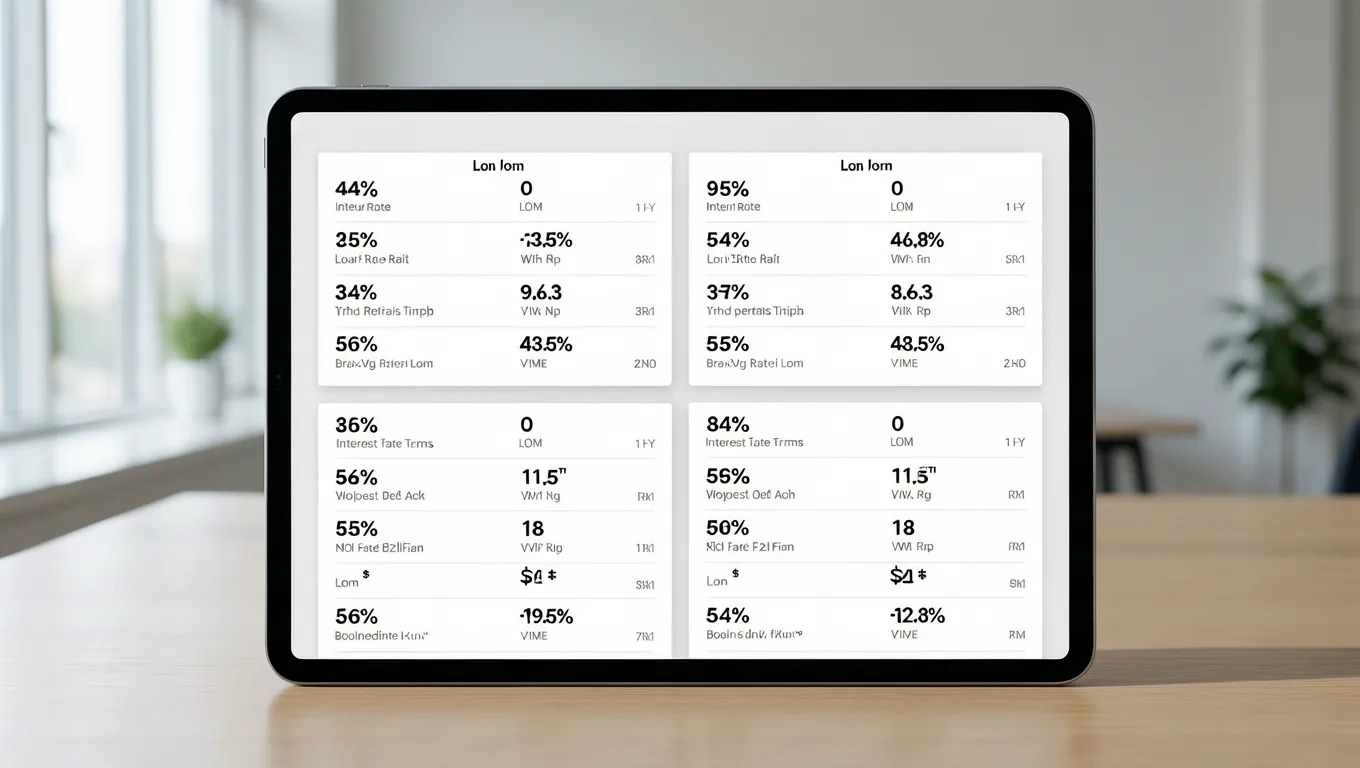
Finding the right financial partner in 2026 shouldn't be a guessing game. Our tool helps you see how different lenders stack up against your specific needs.
No hard credit pull · Takes 2 minutes
Won't impact your credit score
Provide basic information regarding your requested loan amount and financial situation to start the process.
Get a customized view of various <b>APR ranges</b> and terms available from our network of lenders.
Choose the offer that best fits your budget and complete the application directly with the lender.
When you begin a personal loan rates comparison, it is essential to look beyond the simple monthly payment. Many borrowers focus solely on what they will owe each month, but this can be misleading if the loan term is excessively long. A longer term might lower your immediate obligation, but it significantly increases the total cost of borrowing over the life of the loan. In 2026, understanding the relationship between the interest rate and the APR (Annual Percentage Rate) is vital for making an informed decision.
According to guidance from the CFPB, the APR provides a more holistic view because it includes both the interest rate and any mandatory fees, such as origination fees. When you are scanning through different offers, always prioritize the APR if your goal is to minimize the total amount paid back to the lender. For many consumers in 2026, an APR range of 6%–36% is typical, depending heavily on individual creditworthiness and the current economic landscape set by the Federal Reserve.
Your ability to secure a competitive rate often hinges on your debt-to-income ratio (DTI) and your recent credit utilization. Lenders use these metrics to assess how much risk they are taking on when they approve your application. If you have high credit card balances relative to your income, you may find that the rates offered are higher than expected. By performing a thorough comparison across multiple providers, you can identify which lenders are most aggressive in their pricing for your specific profile.
| Credit Tier | Estimated APR Range | Typical Term Lengths | Likelihood of Approval |
|---|---|---|---|
| Excellent (780+) | 6.5% - 12.99% | 24 - 60 Months | Very High |
| Good (670-779) | 13.0% - 19.99% | 24 - 72 Months | High |
| Fair (580-669) | 20.0% - 29.99% | 12 - 48 Months | Moderate |
| Poor (<579) | 30.0% + | 12 - 36 Months | Low/Specialty Lenders |
The results of a personal loan rates comparison are not random; they are a direct reflection of the data found in your credit reports from bureaus like Equifax, Experian, or TransUnion. In 2026, lenders have become increasingly sophisticated in how they weigh different aspects of your credit history. For instance, a high score combined with low credit utilization may yield much better terms than the same score paired with recent late payments.
If you find that the rates being presented to you are higher than expected, it could be due to several factors. One common issue is credit volatility—recent inquiries or changes in your debt levels can temporarily lower your score. Additionally, some lenders may offer specialized products for borrowers with less-than-perfect credit, which often come with higher interest rates but more accessible approval criteria.
It is important to remember that a single comparison does not tell the whole story. Different lenders have different appetites for risk. While one lender might focus on your stable employment history, another may prioritize your collateral or assets. This is why using a matching service like 59 Cash can be so beneficial; we help you see a broader spectrum of what is actually available in the current market.
When evaluating your personal loan rates comparison results, you must account for the total cost of credit. Many borrowers overlook the origination fee, which is a one-time charge taken out of the loan proceeds or added to the principal. While a lender might advertise a low interest rate, an undisclosed origination fee can significantly increase your effective APR.
For example, if you borrow $10,000 and the lender charges a 5% origination fee, you may only receive $9,500 in your bank account. However, you will still be responsible for paying back the full $10,000 plus interest. This discrepancy is exactly why comparing the APR rather than just the base rate is one of the most important steps you can take in 2026.
To avoid being caught off guard, always ask lenders if they charge any upfront fees and how those fees are applied. Some lenders offer no-fee personal loans, which can be a massive advantage for borrowers looking to maximize their working capital. Always read the fine print in the loan agreement before signing to ensure there are no surprises regarding the total amount you will owe.
The duration of your loan, known as the term length, is a critical component in any personal loan rates comparison. In 2026, most personal loans offer terms ranging from 12 to 84 months. The choice you make here will fundamentally change your monthly cash flow and the total interest you pay over time.
A shorter term length, such as 24 or 36 months, typically results in a lower overall interest cost because you are paying down the principal much faster. However, this also means your monthly payments will be significantly higher. For those on a tight budget, a longer term might seem attractive, but it can lead to a heavy financial burden if your income fluctuates.
On the other hand, extending your term to 60 or 72 months can make your monthly obligations much more manageable. The trade-off is that you will be paying interest for a much longer period, which could result in thousands of dollars in additional costs. When comparing options, it is wise to run multiple scenarios: one with the shortest term you can afford and one with a slightly longer term to see the difference in total interest paid.
You may also want to review comparison rates and lowest interest personal loans before deciding what works best.
Knowing your score before you start helps you set realistic expectations for the rates you may receive.
Always look at the APR to see the true cost of the loan including all fees and charges.
Don't settle for the first offer; a quick comparison can reveal much better terms elsewhere.
Adding a co-signer with excellent credit may help you secure a lower interest rate, but it carries risks for them.
We use industry-leading encryption to keep your personal information safe during the comparison process.
Get a clear view of potential lenders and rates in just a few minutes without unnecessary delays.
We connect you with a diverse range of lenders to increase your chances of finding the best terms.
Adjust the sliders to see an instant estimate. Actual rates depend on your credit profile.
* Estimate only. Actual rate and terms depend on lender approval.
Estimated Monthly Payment
$332.14
per month for 36 months
No impact on your credit score