How to Build a Financial Safety Net When Living Paycheck to Paycheck

Marcus Thorne
Senior Loan Analyst · Updated October 2026
Marcus Thorne
Senior Loan Analyst · Updated October 2026
Imagine it is a Tuesday morning in 2026. You receive a sudden notification from your mechanic that your car needs a $500 repair just to remain roadworthy for work. For many Americans, this isn't merely an inconvenience; it is a financial catastrophe that triggers a domino effect of late fees and high-interest debt. According to data frequently cited by the Consumer Financial Protection Bureau (CFPB), a significant portion of households lack even a $400 cushion to cover unexpected expenses. When you are living paycheck to paycheck, every minor mishap feels like a major crisis.
Living month-to-month creates a state of constant hyper-vigilance that can impact your mental health and long-term stability. However, building a safety net is not about having a massive windfall; it is about creating small, intentional barriers between you and financial ruin. This guide is designed to move beyond the generic advice of 'just save more' and provide a practical, step-by-step framework for constructing a buffer when your margins are thin.
In this article, we will explore how to identify hidden spending leaks, why a tiered approach to savings works better than an all-or-nothing strategy, and how to decide whether to pay down debt or build cash reserves first. We'll also look at the nuances of using credit as a temporary bridge during tight months. By the end of this read, you will have a concrete plan to start building security, even if you can only afford $10 or $20 at a time.
The first step toward stability isn't finding more money; it is finding where your current money is quietly escaping. When living paycheck to paycheck, many people feel like they are working harder than ever but still seeing a zero balance by week three. This is often due to 'micro-leakage'—small, recurring costs that do not feel significant in the moment but aggregate into substantial monthly losses.
To stop the leak, you must perform an audit of your last 30 days of transactions. Look for these common culprits:
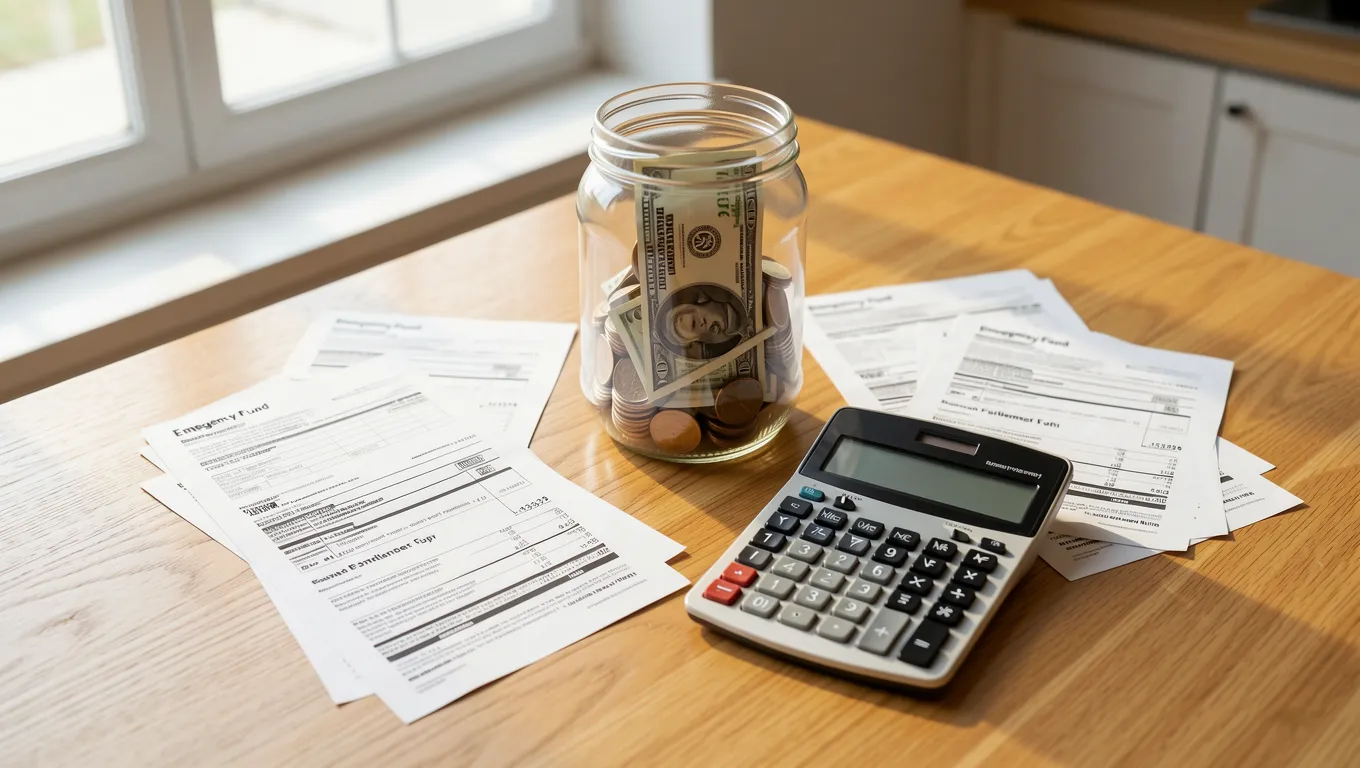
A common mistake that prevents people from saving is the belief that an emergency fund must be thousands of dollars before it is 'real.' If you think you need $5,000 to start, you will likely never start because that amount feels impossible to reach while living paycheck to paycheck. Instead, use a tiered approach designed for immediate impact.
Tier 1: The Starter Buffer (The $500 Goal). Your first objective is not six months of expenses; it is a single, manageable goal. Aiming for $500 provides enough coverage for most minor emergencies, such as a broken appliance or a small medical co-pay. If you can save just $25 per week, you will have your first safety net tier in roughly five months.
Tier 2: The One-Month Buffer. Once the $500 is secure, your next goal is to cover one full month of essential living expenses (rent, utilities, food). For many, this might be a target of $1,800 to $2,500. This tier protects you against larger shocks like a temporary reduction in work hours.
Caveat: Always keep these funds in a separate account from your daily checking to avoid the temptation of using them for non-emergencies.
One of the most debated topics in personal finance is whether to prioritize paying off high-interest debt or building a savings account. The answer depends entirely on the interest rates involved. To make an informed decision, you must compare the cost of your debt against the potential earnings (or lack thereof) from your savings.
Let's look at two scenarios:
When an unexpected expense arises, you face a critical decision: do you use the cash you have saved, or do you put it on a credit card? To make this choice without causing long-term harm, follow this three-step decision framework:
1. Is the expense essential and urgent? A leaking roof is essential; a new television is not. An emergency fund should only be touched for things that are truly unexpected and necessary.
2. What is the cost of the capital? If you have cash in a savings account earning 4% but must use a credit card with 22% APR to pay for an emergency, it is mathematically better to use the cash. You're trading 4% growth for 22% debt avoidance.
3. Can I replenish this quickly? If you use your $500 buffer for a car repair, do you have a plan to rebuild that $500 within the next 60 days?
If the emergency is larger than your current savings—for example, a $2,500 transmission failure when you only have a $1,000 buffer—you may need to look for other options. Some people use personal loans as a bridge. While a loan at 12% APR over 24 months might cost you roughly $117 per month in payments, it can be a more manageable way to handle the shock than a high-interest payday loan or a mounting credit card balance.
The biggest psychological barrier to building a safety net is the 'all or nothing' fallacy. This is the belief that if you cannot save $100 per month, then saving $5 per week isn't worth the effort. This mindset is the enemy of financial progress.
Warning: The habit of saving is more important than the amount in the early stages. If you only attempt to save when there is 'extra money' at the end of the month, you will likely never save anything because, for those living paycheck to paycheck, there is rarely extra money.
Instead, treat your savings like a mandatory bill that must be paid to yourself. Even if it is only $10 per paycheck, that amount builds the 'muscle memory' of saving. It changes your identity from someone who 'can't save' to someone who 'is building a buffer.' Over time, as you identify those leaks we discussed earlier, you can increase this amount incrementally without feeling the sting of a sudden lifestyle change.
In 2026, economic volatility means that 'financial friction'—those moments where your expenses exceed your income for a single month—is a reality for many. The key is to manage this friction without falling into the trap of predatory lending.
When you find yourself in a gap, there are several paths you can take. You might negotiate a payment plan with a utility company, which often results in no interest and more time to pay. Alternatively, some people look for personal loans through matching services like 59 Cash to find lenders that may offer lower APRs than traditional high-interest options. While using debt is never the primary goal of building a safety net, using it strategically can sometimes prevent the devastating cycle of payday lending.
Remember, the ultimate goal of a safety net isn't just about having money; it's about having options. When you have even a small amount of cash set aside, or when you know how to access credit responsibly, you are no longer at the mercy of every single unexpected event. You move from a defensive posture of survival to an offensive posture of management.